
Contents
- Creating a large divot behind my ball.
- How to hit the ball out of the rough?
- Hitting shots thin.
- Problem hooking the ball.
- How to put backspin on the ball.
- Hitting grounders with a lob wedge.
- Overswinging under pressure?
- Tend to slice.
- Is there a correct swing plane angle?
- How can I make my hook a controlled draw?
- Should I stay with the baseball grip?
- Fixing a pesky slice.
- Can’t hit my long irons.
- What is the swing plane?
- How can I stop pushing the ball?
- I keep pulling everything left.
- Fighting a closed club face at the top of my swing.
- Topping the ball too much.
- Is the left hand is the most important in the swing?
- Coach says to change my backswing.
- I have a vicious hook.
- Coming over the top.
- Dipping my shoulder making the ball go to the right.
- Needs help on accuracy.
- Is there a way to cure the flying elbow?
- Tough downhill lie shot.
- At the top of my backswing my club usually points right.
- Usually hit fairway woods fat.
- Feel real tight and short on my backswing.
- Related Articles on GolfSW.com
Questions and answers from junior golfers.
Creating a large divot behind my ball.
Blake Swilley (18) of Joplin, MO, USA writes…
During my recent efforts to improve my swing, I managed to pick up a nasty habit. Now instead of a small divot in front of the ball, I create a large divot behind my ball. I know this is not normal, but i can’t seem to correct it. If there is any advice or practice drills that you know of that can help me?
Scott Robbins:
It sounds as if your swing has become too up and down and not enough around. Try these drills and also go see your nearest PGA Golf Professional for a couple of lessons. Try finding a small hillside where the ball would be slightly above your feet and hit shots from there. Your upper body is moving probably because your club is swing too up and down and the hillside will get you to make a swing more around your body. Also hit balls off of tees 1 -2 inches above the ground. Try and hit the ball and not move the tee. It has a similar effect that a side hill lie has. Junior Golf Tips
How to hit the ball out of the rough?
Michael Cattanach (12) of Ontario, Canada writes…
I am wondering how a guy my age is able to hit the ball out of the rough onto the fairway/green?
Scott Robbins:
To hit the ball out of rough, your swing needs to be a little more up and down. Play the ball back in your stance with your feet closer together. That will help you make the club come down more like a “V” than a “U” and will make it easier to swing the club more up and down and hit the ball out of the rough. Junior Golf Tips
Hitting shots thin.
Sean of Arcata, CA, USA writes…
I hit a lot of shots thin. I find it hard to take a consistent divot. Do you have any advice?
Scott Robbins:
Work on making your downswing a little steeper by trying to swing your arms more towards the ground and ball from the top of your swing. Also concentrate on slowing your body down so that your arms are not following your body into impact.
Problem hooking the ball.
Junior Golf Tips Jason Schmitt of Hiawatha, KS writes…
I have a very bad hook. I’ve tried swinging easier and even moving the ball around in my stance but nothing seems to work.
Scott Robbins:
Thanks for your question. First, I want you to know you already halfway to a good golf swing. Once you star hooking the ball, it is an easier correction than a slice. Excessive hooks come from a couple of places. First, the clubface at impact is closed (looking to the left). Check the clubface at address. The leading edge of the club should make a “T” with your intended target line. Secondly, check your hands. They should be in a palm to palm position (like you are praying) and the back of your left hand should be parallel with the clubface. At impact your hands should duplicate the address position to keep the club looking at the target.
The second place an excessive hook comes from is an exaggerated path into the ball at impact. If the club path is from too far from beside your body to away from your body (too much inside to out swing) you will hit a hook that starts right and goes left. A path that comes towards your body at impact (too outside to in) your hook will start left and go further left. Your swing plane could also be too shallow which means you could be hitting a low roundhouse hook.
There are many reasons. Find the cause. Check clubface and grip first, path and Swing Plane second. Go see your local PGA Professional to get a well trained eye to find the cause and suggest a cure. Junior Golf Tips
How to put backspin on the ball.
Justin Waldrip of Blooming Grove, TX asks…
Whenever I have finished driving the ball and I’m on the fairway. I then use my irons to put my ball on the green, but I hit the ball to hard and it bounces across the green. Could you tell me how to put backspin on the ball so it will “sit down” ?
Scott Robbins:
Justin, that is a great question. Backspin comes from the amount of clubhead speed you can generate. The more spin you generate, the more backspin, the higher the ball flies and the softer the landing. Many people think they have to create the spin. The spin comes from good fundamentals creating a sweeping motion of the clubhead through impact.
I am unsure how old you are, but as you do get older and can create more momentum in your swing that creates speed and you will start stopping the ball at will. See your local PGA Professional for a lesson and have him help you create the swing your are looking for. Junior Golf Tips
Hitting grounders with a lob wedge.
Billy in Amarillo, TX asks…
I got a lob wedge for my birthday and really like it. Sometimes though I hit grounders with it when I use if off of hard fairways. What am I doing wrong?
Scott Robbins:
That’s a great question. One of the most difficult shots is hitting a lofted (sand or lob) wedge off of hard, tight fairways because of the bottom or the sole of the club. All sand and lob wedges have a curved sole. That is the ‘bounce’ of the golf club. What I suspect is happening is that you are allowing the club to “bounce” on the hard fairways and that bounces the leading edge of the club into the ball, producing low flying shots or grounders.
To correct that, try playing the ball back in your stance a couple of inches. That will move your hand slightly in front of the club and ball. Try and swing the club a little more up and down, trying to pinch the ball off the hard fairways. That should produce a lower than normal ball flight but also enough spin to hold the green.
Good luck with the shot. If you have any problems go see one of the PGA professionals in Amarillo. And also, Happy Birthday!! Junior Golf Tips
Overswinging under pressure?
Charlie Moore in San Antonio, TX asks…
My son has been working with an assistant teaching pro for a couple of seasons, and seems to be making good progress. However, I worry that he overswings, especially under pressure, or when he tries to kill it. He is 13. Do you think this is a potential problem, or is this ok when players are just learning to play and are more flexible?
Scott Robbins:
Golf is a game of never ending continual learning process. No, I would not worry that your 13 year old son has a tendency to overswing under pressure. Consider that normal. One of the things the tour professional learns is how to deal with the adrenaline rushes that “pump” them up and make them hit their shots farther than they knew they could.
Your son will learn how to deal with his “rushes” with continued coaching and most of all experience. There is a young man by the name of Tiger Woods that used to overswing in his early years that through coaching and experience is continuing to learn to control his swing in pressure situations.
Let experience and coaching solve this “potential problem” in it’s own good time. Continue to encourage your son to have fun playing golf and provide him the coaching he needs. Junior Golf Tips
Tend to slice.
Mike Campbell of Detroit, Michigan writes…
My problem is that I tend to slice the ball. It is a shot that starts to the left and comes around so that it finishes severely to the right of the target. I have checked my divots, and it appears that I am swinging the club on an outside to in plane. With my shorter clubs I usually get away with this, but with my long irons and woods I almost have no chance to hit the ball straight.
Scott Robbins:
A slice is the most common of all problems in golfers. The main reason is that the golfer tries to swing the club too straight towards the target. Since you are standing to the side of the golf ball, that is an impossibility. If you would look at the golf swing from above, you would see the swing is an inside to inside golf swing. However, the golf swing is a chain reaction of events where our downswing is set up by your backswing.
It all though starts with fundamentals. Check your posture and set up first. (Read my article on the 5 P’s.) Check your grip to see you are holding your hands in a preying position where the palms are facing each other and your are holding the club more in your fingers than in your palms. Once your posture and grip are better then you should work on feeling as if you are swinging the club head back so that the club head, arms and hands do not change relationship with each other. The hands and clubhead should remain in front of your chest till the club is almost waist high.
On the downswing, try and make your divots look right. Golf is a game of opposites. You see that with your current shots. You swing the club steep and to the left and the ball ends up right. You want to do the opposite now. Coming into the ball, you should sweep the ball off the ground and feel like your arms and club are swinging to the right of target through impact. Junior Golf Tips
Is there a correct swing plane angle?
John Lagel of Cambridge, OH asks…
Is there a correct swing plane angle that I need to stay within? My father tells me that I am to flat on my swing plane and I need to get my swing plane on a higher degree of angle. Thank you very much for any help you can give me.
Scott Robbins:
John, Great question! Yes there is a correct swing plane you need to stay on. To hit the most solid, farthest and straightest shots your club must return to the ball where it started at address. Your swing plane will be dictated by your height and body structure. Once you are in the proper set up, your swing plane with your body will be dictated by your spine and shoulder tilt and angle. The shoulders should rotate around your spine and your back arm should hinge in the backswing and front arm in the follow through. Your plane at the top of your backswing should then have your forward arm parallel to your shoulder angle you set at address. Junior Golf Tips
How can I make my hook a controlled draw?
Judson Weaver of Sulphur Springs, TX asks…
What can I do to make my hook more of just a controlled draw?
Scott Robbins:
Judson, First of all congratulations on hooking the golf ball. That is the first step to becoming a better player. Some things to check to see the type of hook you are hitting.
The first place is to check the divot after hitting an iron shot in practice. Is the divot facing left or right of target and is the outside or toe portion of the divot deeper than the inside or the heel portion. Is the divot flat and wide or narrow and thin. The next place to check is your driver. Are the tee marks moving from the center of the face to the toe or the center towards the heel. These will diagnose the problem early.
First if the heel is deep on the divot and the divot is pointing right of target, then you have a too closed face with a too inside move to the ball. If the opposite is happening then you are hitting more pull hooks than hooks and that is caused by an outside path into the ball. All this leads to a few things to check.
First is your application of your hands to the club. They should be palm to palm with the club nestling towards the base of the fingers and the v’s between your forefinger and thumb on your left hand should point to your right eye or ear and the v on your right should match the left or preferably point at your chin. Your hands, palm to palm should be parallel to your clubface. The clubface square to target and hands parallel to the target line.
Secondly check your posture and alignment of your body. A too inside path can be set up from an excessive lowering of the right (assuming you play right-handed) shoulder. The shoulders should be level, centered over the hips and the hands should be centered between your legs. Third, If your divot is too far right, try and slow your body down and let your arms swing towards your left leg. If your divots are to the left, try and slow your arms and speed up your body and swing your arms to the right of target. Junior Golf Tips
Should I stay with the baseball grip?
Scott Hicks of Westchester, OH writes…
I have been taking golf lessons for three years, this is the first summer I have played on a true golf course. This fall I made the J.H. golf team. I have been using a baseball grip and the coach is trying to switch me to a interlocking grip. I experience no slice or hook , should I try and switch or stay with the grip I now use?
Scott Robbins:
The golf grip serves two purposes. One is to square the clubface with the body and the other is to connect the big power muscles and transfer the power to the clubhead. The formation of that grip is determined by some personal things to each golfer. These include hand, wrist and arm strength; hand size; and personal preference. The goal of the grip is to unify two hands into one unit that is square to the clubface and help square the clubface at impact and that will work together with the bigger muscles of your body to transfer the power generated by those muscles to the clubhead and ball.
My preference in instruction is the Vardon (also known as the overlapping) grip. I think it is the best way to unify the hands. However I do have pupils that have better success with the interlocking and full finger (you refer to it as a baseball) grips. If your hands are unified, square and control the club from twisting at impact, then I say use the grip you are using until you get too strong and feel one hand trying to dominate the other in the swing. Until that happens, as we say in Texas, “dance with the one who brung ya’.” Junior Golf Tips
Fixing a pesky slice.
Stephen Johnston of Campbell River B.C, Canada writes…
I can’t get rid of my pesky slice, every time I hit the ball off of the tee my ball goes into the trees. I play at a hard course and my game keeps on getting worse, can you help????
Scott Robbins:
Stephen, Slices are the most common complaint the instructor will get. You slice the ball because your clubface at impact is facing right of target or your swing path or both and usually from the club chopping down at the ball instead of sweeping through the ball.
There are a lot of places to check.
First check your grip. Be sure your hands are facing each other in a palm to palm “praying” type position. Then be sure to hold the club more in the fingers than the palms so that you cannot twist the club in your hands.
Secondly check your address and alignment positions. Alignment should be like the letter “H.” The far side of the letter should be your target line, the near side should be your feet and body line and the crossbar should be your club. You should be in an athletic posture. You should look as if you are ready to play defense as a guard in basketball, a short stop in baseball or a goalie in Hockey. Bent over at the waist, knees slightly flexed and spine straight.
Once you have a good grip and a good posture and alignment you are ready to swing. To keep the clubface square at impact you should concentrate on the club moving back by turning your chest away from target and holding the club over your back shoulder so that the back of your wrists are flat and in line with your forearms. From that position at the top you should then try and swing the club away from your body through impact so that your arms extend towards target after impact. Junior Golf Tips
Can’t hit my long irons.
Mike Stuewe of Cleveland, OH writes…
My problem is I can’t hit my long irons. I can hit my 9 iron 110, my 8 iron 120, my 7 iron 135, and my 6 iron 155. My 3,4,5 iron bounce around 110. They stay low and feel like I’m hitting a rock. Can you help me?
Scott Robbins:
Mike, It sounds as if your swing is too “choppy” with your longer clubs. This chopping motion shrinks the size of your swing which in turn lessens club head speed which in turns doesn’t create enough momentum to make the golf ball go far.
Try and start sweeping all your longer irons, if not all your irons. The wider and shallower (lower) you can bring the club back and through, the farther you will hit it. Find a PGA Professional in Cleveland that can look at your swing and recommend the changes necessary to hit all your clubs! Junior Golf Tips
What is the swing plane?
Tyler Griffith of Palm City, Florida writes…
I’m just beginning to golf (about 3 weeks now) and I think I got a knack for the sport. I just have a couple stupid questions that I’m too embarrassed to ask 🙂 First, when pros chip a huge hunk of grass always flies up with the ball. Is that supposed to happen? Whenever I try to do that my club just stops. Second, I have no idea what all this plane stuff is, could someone explain?!?! thanks a bunch
Scott Robbins:
Tyler, There is no such thing as a stupid question!! We ask questions when we don’t understand things as you have done.
The chunks of earth or divots you see the tour players take is usually with the short irons which are short and upright (shaft doesn’t lean as much towards the body) and therefore creates a more up and down swing which will dig slightly into the ground. Your goal should be to try and sweep the ball off the ground with each swing. One of the greatest players of all time, Byron Nelson won 11 tournaments in a row and 13 total in 1945. Another pro, Jug McSpaden said the reason Byron was so good was because he never took a divot and could control the ball better than anyone else. Learn how to sweep the ground instead of digging into the ground.
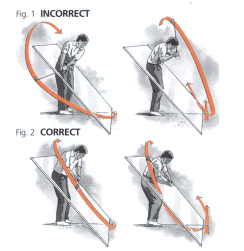
Finally, let me try and clarify the swing plane. The simplest way is to ask you to get a hula hoop or bicycle tire and hold it parallel to the ground. That is what your baseball or tennis swing could look like. Hold it one the ground like it would be to ride on it on your bicycle. That is what your bowling or croquet swing will look like. Now take that hoop or bicycle tire and hold it against a golf club that is soled on the ground. That wheel or hoop is what your swing should look like. That hoop that your swing will follow is the “plane” of your swing. I hope this helped. Junior Golf Tips
How can I stop pushing the ball?
Cody Darley of Utah asks…
How can I stop pushing the ball?
Scott Robbins:
Cody, if you are straight pushing the ball (without a curve to the right or left and just straight away from your body) then it usually means the club is traveling on too much of an inside path into the golf ball and/or the ball is to far back in your stance. To correct that there are a few good drills. One is to stand with your feet close (2-6 inches) together and try and hit golf balls swinging the club more to the left on the follow through. Another is to play the ball in front (more towards target) of the toe of your front shoe. Hit golf balls from there. This promotes you to bring the club and body through together to make contact with the ball.
A third drill is to take short swings (just past your back leg on the backswing and just past your leg on the follow through) wile keeping the butt of the club pointing at your belt buckle (or belly button). This too promotes the feel of your body and club working together to make square contact and straighter shots.
I don’t say this to state the obvious but to point out that whatever shot, club or approach it takes to get the ball in the hole do it.
The other side of that story is the practice range. Here is where you improve your technique. The problem you are having sounds like the club is coming too steeply at the ball (chopping motion) an from the outside. This motion produces pulls, pull slices, tops, pop ups, fat shots, deep divots among other things.
Learn to sweep the golf ball. Borrow the broom from your Mom and start to swing the broomstick trying to sweep the ground. Learn that same motion with your golf swing and you will never have problems hitting the ball off the ground again. Go see a PGA Professional for help with your swing. Do it now before you develop habits that you can’t ever seem to shake. Junior Golf Tips
I keep pulling everything left.
Dan of Garden City, NY writes…
I’ve been playing for about one year and my problem is with my short irons. I keep pulling everything left. Any suggestions for improvement are greatly appreciated!!
Scott Robbins:
A pull indicates a swing path into the ball from outside the target line to inside the target line. It is usually made by trying to swing the club too straight towards target. Once you are properly lined up (feet and body parallel to the target line) and in the right posture you will notice that you are to the side of the golf ball. This makes it impossible to swing the club straight down the line. Your swing should always be to the inside and from the inside coming into impact.
The short irons are a great place to change your swing. Work on alignment and posture first and than as you swing you want to feel as if your arms are swinging away from your body and you are actually swinging the club to the right of target.
Start here and also go find a PGA Professional in your area to take some lessons from to learn your swing. The TOUR players do, so it can work for you also. Good Luck, Have fun for the rest of your life playing this great game. Junior Golf Tips
Fighting a closed club face at the top of my swing.
Josh Hartloper of Anderson, S.C. writes…
I have problems with fighting a closed club face at the top of my swing. I fight my club take away position at 9:00. What are some good tips for correcting these problems, and what are some good drills?
Scott Robbins:
Check your grip first. Be sure it is square at address and at 9:00. At 9:00 the face should be parallel to your spine.
After a grip check and correction (if necessary), check your takeaway. Be sure your hands, arms and chest are all moving together. Be sure the club remains within the triangle of your hands and arm.
A closed clubface at the top indicates that the clubhead has fallen behind the hands somewhere in the backswing.
Find your nearest PGA Professional and have him check your grip and takeaway and recommend some specific drills to correct you specific problem. Junior Golf Tips
Topping the ball too much.
Craig Miller (6) of Cabin John,Maryland writes…
I’m topping the ball too much. Can you give me some tips?
Scott Robbins:
What a great age (6) to be already playing golf. You will have memories of this time for your whole life.
Topping the ball can come from many areas. Something is happening in your swing to lose sight of the ball as you swing into the ball. Therefore, I want you to try a little experiment. When you go practice take with you a crayon or a marker. Draw a face, circle or whatever you want on the ball. When you set the ball down, put the drawing on the back of the ball slightly facing you. Then concentrate on seeing the club hit that drawing and then check to see if you did by checking the clubface after you hit your shot.
Good Luck and I look forward to seeing your name on the PGA Junior Tournament series when you are 14-18 years old. Junior Golf Tips
Is the left hand is the most important in the swing?
David Melancon in Hahnville, Louisiana writes…
I was always told that the left hand is the most important in the swing but I was recently told by J.C. Snead at a clinic that my right hand is the most important. can you help me?
Scott Robbins:
I believe that the hands have two functions in the golf swing. First, and not necessarily in importance, is that the hands align the clubface with the body, more specifically, the spine. Secondly, the hands act as a connector between the club and the big muscles of your body in your shoulders, trunk and legs. Therefore the hands need to properly align the clubface with your swing mechanics and hold on to the club throughout the swing to be able to transfer the energy you generate with your body to the ball.
Which hand then is more important? Neither and both. They need to work together as one unit and they each have their separate functions.
Find a PGA Professional to help you work on your swing and quench your thirst for knowledge by reading as many books as you can, concentrating on the explanations and the different ways the fundamentals of the golf swing are conveyed. Junior Golf Tips
If you enjoy betting on golf, read this review of the bet365 bonus code welcome offer at https://freebetpromocode.co.uk/bonus/bet365-bonus-code – all new members receive a huge welcome bonus!
Coach says to change my backswing.
Chris Taylor in St.lucia, West Indies asks…
If my old swing was producing straight and accurate shots most of the time and I was told by a coach from Europe to change my backswing in to something not natural, therefore having to think about my swing as I am doing it, do you think I should listen to the coach or should I use my old swing since it was very consistent and I could rely on it under pressure?
Scott Robbins:
Changes in golf swings are very difficult. When touring professionals consult their coaches, they usually do not have a lot of time to work on those changes between tournaments so they will hit lots of balls to get the swing change in. However, the physical change happens faster than the mental change does. What I mean by that is that after all the practice they have to go play with the new changes and trust that they will work on the golf course. It takes a while to learn to trust it on the course and therefore build confidence in the swing.
A good example is PGA Champion Mark Brooks. Mark was struggling with old swing habits in April and worked with his coach, Doug Higgins, Jr. at The Masters. He later in May won the Houston Open and in August he won the PGA Championship.
Trust between player and coach is important. If what your coach is changing is occasionally producing better golf shots, then work with it. Swing changes and new moves don’t immediately produce better golf shots but if you are seeing some better shots, stick with it. Once the change gets in, your golf game will be more reliable and pressure proof.
I have a vicious hook.
Danny Bilbao of Brigham City, Utah writes…
My problem is that I have a vicious hook. I am sure that it is caused by two problems: at the top of my backswing I go across the line and my clubface points to the sky.
Scott Robbins:
It sounds like you have described a couple of common symptoms of a viscous hook. So, what is the cause of these symptoms. A skyward pointing clubface can be one of two things or possibly both. The first is a very “strong” grip where the hands are turned to far towards your body (to the right if you play right handed).
The second is and excessive rolling of the hands or arms on the takeaway and backswing, usually caused by trying to get the “toe up” at waist high in the swing. I suspect it is both because of the second symptom you described, the club crossing the line at the top.
I frequently see the crossed club when I see a takeaway that has moved way inside the shaft plane set at address and is behind the hands quickly in the backswing. Sometimes this is caused by the hands being set way in front of the ball at address. This “forward press” move sets the hands in front of the club at start and when the club is taken back, it is far behind the hands and arms and when he club is eventually lifted to the top, the result is a crossed club.
Therefore, check your setup first. Check to see if your hands are properly placed on the club. Secondly make sure the shaft of the club is set between your forearms instead of in line with your target (left) arm. When swinging the club away from the ball and into the ball, be sure the shaft of the club stays between your arms. Junior Golf Tips
Coming over the top.
John in New York writes…
I am coming over the top real bad. My divot points points left and I feel myself lunging at the ball producing a rather weak left to right shot. In the past my ball flight was a draw right to left, I was never right. Now its completely going the other way. HELP!!
Scott Robbins:
John, Let’s get back to that draw!!!
The path of your downswing is too much from the outside. There are many possibilities for the cause. Check your set up first, making sure you are in a balanced and athletic position. Secondly, check your backswing. The reason I say this is that when someone is lunging at the ball and coming across the line, it is sometimes because their arms are out running their body. That will sometimes start in the backswing when the arms start first and then fall behind the body. The reaction is for the arms to speed up and outrun the body on the downswing.
How to you fix it? First tee up a ball and put a tee on each side of the ball a little wider that your clubhead. Then try and hit the teed ball without disturbing the other tees. This will help you produce a more rounded sweeping swing instead of a choppy across your body motion. Work on that for a while and get yourself to the nearest PGA Professional for a diagnosis and a lesson as soon as possible. Junior Golf Tips
Dipping my shoulder making the ball go to the right.
Beau Burgess (16)of Flower Mound, TX writes…
I am usually a good golfer, but lately I have been dipping my shoulder making the ball go to the right. How would you correct this? Thanks, Beau
Scott Robbins:
It sounds like you have diagnosed the effect of your golf swing. The question is, what is making you dip your right shoulder? The ball going to the right means the clubface is open at impact and if the right shoulder is dipping, it sounds as if the club is coming into the ball form and outside path. Therefore, try to check the path of your swing coming into the ball. Try to swing the club to the right with more arms than body and square the clubface with your arms and hands. Junior Golf Tips
Needs help on accuracy.
Joseph Morgello (14) of Port Jeff Sta., NY, U.S. writes…
I am a junior golfer who is very serious who needs help on accuracy. Do you have any advice?
Scott Robbins:
Accuracy comes from having your clubhead, swing path and swing plane all facing the target at impact. Before you start fixing, find the right diagnosis first. Check your divots and your clubface first. See the direction your divots are facing after you hit the ball. Anything but at the target will tell you if it is a swing path problem.
Facing left is too far from the out side. Too far right is too far from the inside. If your divots are too deep in one area then your swing plane is too steep. If there is barely any divot that indicates either a too shallow plane or a lifting after a couple of real deep divots. If the divot is narrow from side to side that means that the clubface is either open or closed at impact. Too deep to the outside, too open and too deep to the inside is too closed.
After you have “read” you divots then you can start adjusting the part of your swing that is causing your accuracy problems. Junior Golf Tips
Is there a way to cure the flying elbow?
Sean Ali (15) of Midland, Ontario, Canada asks…
Is there a way to cure the flying elbow?
Scott Robbins:
To cure a flying right elbow. There are a couple of things I can describe that can help. First at address, be sure both of your elbows are pointing at your hip bones. Secondly, as you take the club away from the ball, be sure your wrists are cocking in an up and down motion (like you are using a hammer) and not moving from left to right. When the wrists move improperly, the shove the elbow behind your body and it looks to be “flying” at the top of the backswing.
Another great drill to create the proper feel is to use a soccer ball or large bed pillow between your elbows and against your chest and make your backswing over and over again. That will give you the feel of your elbows staying together on the way back. Junior Golf Tips
Tough downhill lie shot.
Mitchell (14) of Randolph, WI writes…
I started to play golf serious this last year at a hilly course. I have no problem with uphill lies. I would be having a good round and then I would come to this tough downhill lie shot and threw my whole game off. What is your recommended position for this shot.
Scott Robbins:
First realize that where you are learning to play golf is great because you are learning under some of the most difficult conditions. And probably the most difficult long or full shot that can be played is from a downhill lie.
The lie sets your body to move ahead of the club at impact, close the face, hit the ground before the ball and dig too deep into the ground. Besides all that, it is an easy shot! So, how do you counteract all these factors?
Since your body will move ahead of the ball, set your weight into the hill towards your back foot. The center of your swing will also move up the hill and towards the back of your stance so you can move the ball back in your stance. The clubface will close or more importantly de-loft so use less club form the same distance as you would from a flat lie. Your body will want to move forward so try and stabilize your body during the swing and feel like you swing the club a little more with your arms. Once you have your body set, also try and set your shoulders parallel to the slope. This will counteract the tendency to dig into the ground and hit behind the ball.
GO out and practice these techniques. Learn this shot well and you will be on your way to being an even better golfer. Remember, this is one of the hardest shots in golf. So if it does not work out, that’s okay, you gave it your best try. Go find the ball and hit the next shot to the best of your abilities. Every golfer and every round of golf has some flaws in them. When you learn to accept that, the hard or bad shots will not completely destroy your round.
Learn from the Tour players. Tiger Woods three putts twice on the back nine of Saturday’s round of the Tournament of Champions. He then finishes with 4 birdies in a row and shots 65. Curtis Strange on Saturday of the Bob Hope tournament a week later makes a triple bogey on the 8th hole. He finishes the round under par and still in position to finish with a good check for the week.
Learn how these guys take mistakes in stride, realize they are human and will make mistakes but try to do their very best over every single shot. And if they don’t, how they accept that too because they are human. Junior Golf Tips
At the top of my backswing my club usually points right.
Anton Adams (16) of Vancouver, WA USA writes…
I am a right handed golfer and at the top of my backswing my club usually points right of the line parallel to the target line. Some people say it’s because of a flying elbow but I’m not sure. Also when I see a picture of a pro in a magazine usually his left wrist is strait but at the top of the backswing my wrist is cupped. I was wondering if this is bad. Thanks
Scott Robbins:
It sounds like you have a good handle on what is happening at the top of your swing. You want the back of your left wrist straight and in line with your forearm and clubface. When this happens, the club will probably be parallel to your target line end parallel to the ground at the top of your swing.
The bigger question here, Anton, is how did the club get there? Find a PGA Professional that can check out your takeaway and see that your club is not changing positions in the first 24-36 inches of your swing. Check to be sure that the handle, shaft and club head all go back together and in the same line they were at address. It sounds as if your club head is going back towards your body too fast and is causing some of the corrections that result in the positions you are seeing in the top of your swing.
Junior Golf Tips
Usually hit fairway woods fat.
Andrew Lewis (14) of Clarksville, AR , U.S. writes…
I am having trouble hitting my fairway woods, especially my 3 wood. I usually hit it fat or just not solid.
Scott Robbins:
Sounds like you are on your way to a great high school golf career! Hitting shots fat usually means a couple of things. The body is arriving to the ball before the arms and club and/or the club is too steep (too high and straight) coming into impact. It could also mean the shaft is too weak in your 3 wood that will also cause the shaft to stay behind your body and hands at impact.
First check to see if the 3 wood shaft is the same as your irons and driver. To cure a too steep downswing, I recommend a couple of things to try. First work on feeling your right shoulder staying back as your arms swing into the ball, attempting to make a more “U” shaped attack at the back of the ball instead of the too steep “V” shape you may be having.
Secondly, to feel this more round and shallower swing, place a long twig in the ground so it’s top is about shin or knee high to you. Then swing the club trying to clip the top of the twig. As you get better, lower the twig a couple of inches at the time until you are just brushing the ground with whatever club (iron or wood) you are swinging. The more sweep you make, the better your swing will be and the better your shots will be. Junior Golf Tips
Feel real tight and short on my backswing.
Doug Stinson (18) of Charleston, WV writes…
I’ve had a real problem cocking my wrists on the backswing lately. I always have had a long smooth swing but, lately I feel real tight and short on my backswing. I believe its from
not cocking my wrists properly. Do you have any drills to help? Also my weight shift has been a little off. Should you or should you not keep your right leg stiff on the backswing. Explain what you believe is the
proper way to shift weight.
Scott Robbins:
The feeling of being “bound” or “locked” up usually stems from the arms falling behind the body on the backswing. Furthermore, it restricts your wrist cock your body adjusts to balance itself by falling forward towards the ball and target, further restricting rotation and weight shift.
This sounds like what is happening in your golf swing. A good drill would be one where after you apply your hands to the club you take your right (if you play right handed) hand and split it from your left till your right hand is at the bottom of the grip, almost to the shaft at the bottom of the grip. Then feel like you swing your arms and shoulders together till you have moved the club and handle of the club past your right leg. At this point, fold your right arm straight up and complete your shoulder turn. You want to feel how the club stays “out in front” of your chest throughout the swing and the freedom to turn your chest. At this point, if this drill is done right, your weight will be towards your back foot without any effort.
The swinging out of the arms and the simultaneous rotation of the chest is what creates the weight shift in the backswing. Therefore, learn to swing your arms more going back, get them in front of your chest and I believe you will get that good smooth feel you know as your golf swing.
Try this and if you are still struggling, find a local PGA Professional that will help you with your game.
Bet on your favorite PGA golfers at MyBookie.ag! Read this review of the MyBookie promo codes at https://usacasinocodes.com/mybookie-bonus-codes-promos/ and choose your welcome bonus. Read other reviews of the top USA sportsbook promotions at USACasinoCodes.com.
Related Articles on GolfSW.com






Submit your review | |